
Active Harmonic Filter (AHF)
Advanced Harmonic Mitigation for Non-Linear Industrial Loads
What is an AHF?
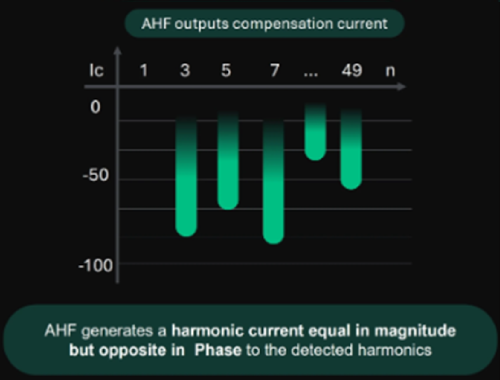
An Active Harmonic Filter dynamically analyses current waveform distortions and injects equal and opposite harmonic currents, ensuring a clean sinusoidal waveform.
It eliminates harmful harmonics produced by VFDs, UPS systems, LED drivers, SMPS loads and a wide range of modern electronics.
Working of Active Harmonic Filter
- CT continuouslymeasures the load current(which includes both fundamental and harmonic components).
- Themeasured currentis sent to the DSP (Digital Signal Processor) or microcontroller in the AHF.
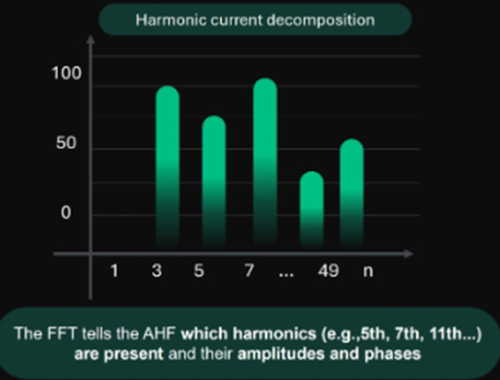
- Real time FFT harmonic detection is appliedto break down the complex current waveform into its frequency components:
This is done using an IGBT PWM inverter AHF- “Equipped with a high-speed IGBT PWM inverter, the Active Harmonic Filter dynamically responds to load variations, delivering consistent THD reduction even under rapidly changing conditions.
- The compensating harmonic current isinjected into the linethrough a coupling inductor
- This current cancels out the harmonic componentsin the load current.
- The source (utility or generator) now supplies only thefundamental current.
Ideal For
- Plants with high harmonic distortion (THD > 8%)
- VFD-based machinery
- UPS and IT loads
- Data centers
- Welding machines
- Elevators
- Printing & packaging industries
- Commercial buildings with non-linear loads
- Facilities facing transformer overheating
Key Benefits
- Filters harmonics from 2nd to 51st order
- Reduces THDi to <5%
- Real-time response with high-speed DSP control
- No risk of resonance
- Improves system reliability & equipment life
- Corrects reactive power support for both inductive & capacitive loads
- Works with 3P3W and 3P4W networks
- Modular design with parallel expansion option
Technical Advantages
- IGBT-based inverter technology
- Fast switching for accurate compensation
- Neutral current mitigation in 4-wire systems
- Advanced FFT analysis with closed-loop feedback
- RS485 / MODBUS / optional wireless monitoring
- Natural/forced air cooling options
Technical Data Sheet
Electrical Specification | |
Rated Voltage | 400V(300~456V) |
Rated Current | 15/25/50/75/100/150A |
Circuit Topology | Three Level IGBT |
Network Configuration | 3P3W/ 3P4W |
Mains Frequency | 50/60Hz±5% |
Filter range | 2nd~51st odd order harmonics |
Filtering Performance | Typically, THDi≤ 5% at rated load |
Target Power Factor | Adjustable from -1.0 to +1.0 |
3 Phase Load Balancing Effect | ≤5%, Mitigate negative and zero sequence |
Overall Response time | ≤5ms |
Multi devices in parallel | Up to 12 sets can be connected in parallel |
Output current limit | Automatically limited within 100% of rated capacity to output |
Control Technology | |
Switching/control frequency | 25.6kHz |
Control algorithm | Intelligent FFT, Self-adaptive control algorithm |
Communication protocols | communication interface adopts RS485 and CAN bus, supporting mobile phone APP operation |
Physical Specification | |
Human Machine Interface | 7 inch touched LCD HMI |
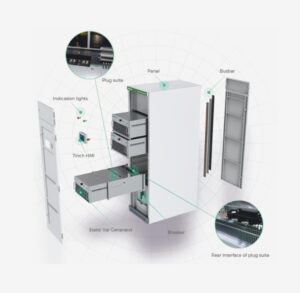
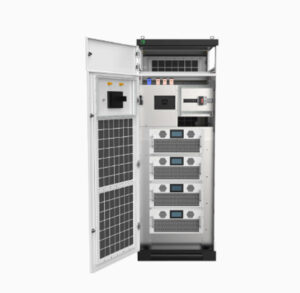
Installation method | Rack mounted, wall mounted |
Level of protection | IP20 |
Environmental Specification | |
Environment temperature | -20 ~ 55 ℃ (rated power output) |
Storage temperature | -30~70℃ |
Relative humidity | 95 % at a maximum, no condensation |
Altitude | Below 1500 meters above sea level |
Cooling requirements | Require well ventilation, and the air vent can be opened through the cabinet door, or a fan installed in the cabinet |
Products Portfolio
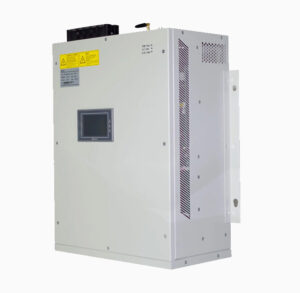
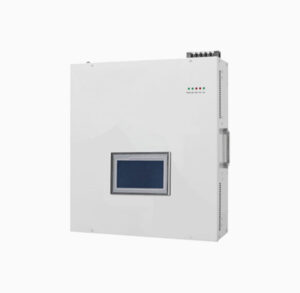
Typical Applications

Industries using VFD-driven motors

Solar inverter-based plants

Plastic, textile, metal & food processing plants

Data centres & IT parks

Commercial buildings with heavy non-linear loads

Hospitals (MRI, CT, X-ray, critical loads)
Mechanical Drawings


FAQs
Triplen harmonics
What are triplen harmonics?
Triplen harmonics are odd harmonics that are multiples of the 3rd harmonic, such as the 3rd, 9th, 15th, and 21st. Unlike other harmonics, they add together in the neutral conductor instead of cancelling out, which can lead to excessive neutral current.
What causes triplen harmonics?
Triplen harmonics are mainly generated by non-linear single-phase loads such as:
- SMPS (Switched Mode Power Supplies)
- Computers
- Servers
- LED lighting
- UPS systems
- Office equipment
What problems do triplen harmonics create?
Triplen harmonics can cause:
- Neutral conductor overheating
- Transformer overheating
- Increased power losses
- Reduced equipment life
- Higher energy costs
- Nuisance tripping of protective devices
Zero Sequence Harmonics
Why are Zero Sequence Harmonics dangerous?
These harmonics accumulate in the neutral conductor, causing excessive neutral current, overheating of cables, transformers, and electrical panels, which can reduce equipment life.
Which harmonic orders are Zero Sequence Harmonics?
The most common zero sequence harmonics are the 3rd, 9th, 15th, 21st, and other multiples of three.
What causes Zero Sequence Harmonics?
They are mainly generated by non-linear single-phase loads such as computers, LED lighting, UPS systems, office equipment, and switch-mode power supplies.
How can Zero Sequence Harmonics be reduced?
Zero sequence harmonics can be minimized by using Active Harmonic Filters (AHF), K-rated transformers, harmonic mitigating transformers, and proper electrical system design.
Positive Sequence Harmonics
What are Positive Sequence Harmonics?
Positive sequence harmonics rotate in the same direction as the fundamental three-phase supply and generally have less impact than negative sequence harmonics.Positive sequence harmonics include the 1st (fundamental), 7th, 13th, 19th, 25th, and other harmonics following the sequence pattern.
Do Positive Sequence Harmonics affect electrical equipment?
Yes. Although they rotate in the normal direction, excessive positive sequence harmonics increase total harmonic distortion (THD), causing additional losses and heating
What are the common sources of Positive Sequence Harmonics?
Variable Frequency Drives (VFDs), rectifiers, inverters, industrial automation equipment, and other non-linear loads.
How can Positive Sequence Harmonics be controlled?
They can be reduced using Active Harmonic Filters (AHF), passive harmonic filters, and proper harmonic mitigation techniques.
Positive Sequence Harmonics
Why are Negative Sequence Harmonics harmful?
They produce reverse torque in rotating machines, resulting in overheating, vibration, reduced efficiency, and possible motor failure. Negative sequence harmonics commonly include the 5th, 11th, 17th, 23rd, and similar harmonic orders.
What causes Negative Sequence Harmonics?
They are generated by non-linear loads such as Variable Frequency Drives (VFDs), six-pulse rectifiers, arc furnaces, and other power electronic equipment.
How can Negative Sequence Harmonics be minimized?
Negative sequence harmonics can be reduced using Active Harmonic Filters (AHF), multi-pulse rectifiers, line reactors, and proper harmonic filter design.