
Static Var Generator (SVG)
Intelligent Power Factor Correction — Real-Time, Accurate, Maintenance-Free
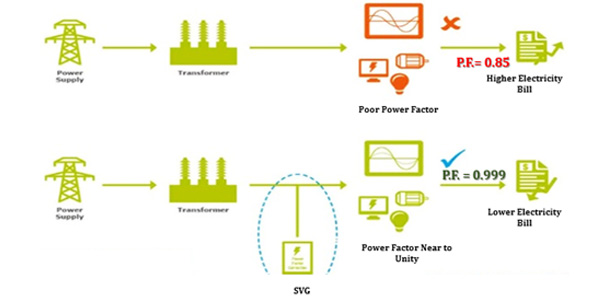
What is an SVG?
Ideal for
- Elevators, HVAC & cranes
- Injection moulding machines
- Pharma packaging lines
- Hospitals & labs
- Commercial complexes
- Any facility with fluctuating loads
Key Benefits
- Maintains PF up to 0.98 – 0.99
- Response time of milliseconds
- Step-less compensation for dynamic loads
- Improves voltage stability
- Corrects 3-phase imbalance
- No capacitor ageing or maintenance
- High efficiency & compact structure
Technical Advantages
- DSP-controlled inverter technology
- Works for inductive as well as capacitive loads
- Modular kVAr-based build
- Compatible with rapidly varying loads
- Seamless integration with new or existing electrical systems
Technical Data Sheet
Electrical Specification | |
Rated Voltage | 400V(300~456V) |
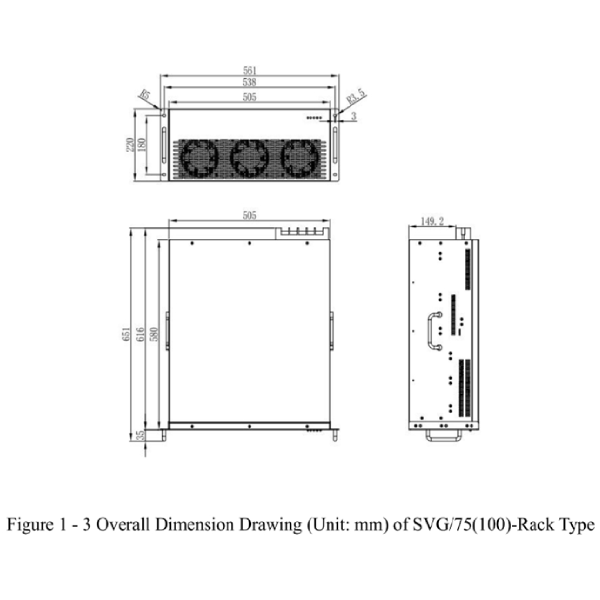
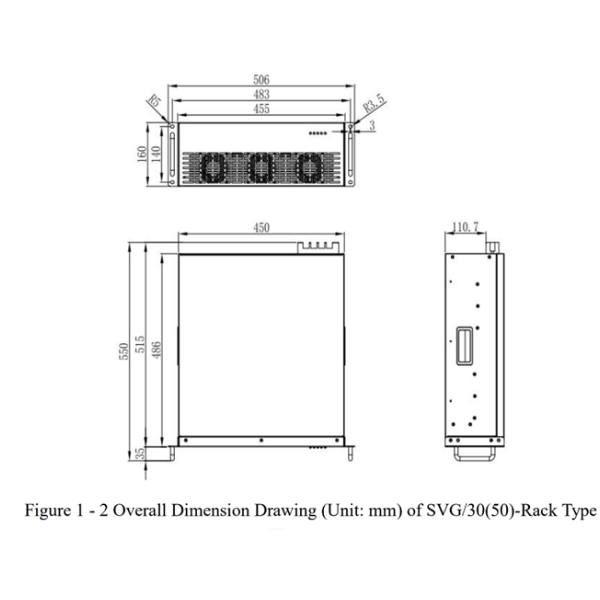
Rating | 30/50/75/100kVAr |
Circuit Topology | Three Level IGBT |
Network Configuration | 3P3W/ 3P4W |
Mains Frequency | 50/60Hz±5% |
Reactive Power Compensation Capability | Both inductive and capacitive reactive power |
Reactive Power Compensation Performance | Cosφ ≥ 0.99 after compensation |
Target Power Factor | Adjustable from -1.0 to +1.0 |
Overall Response time | ≤5ms |
Multi devices in parallel | Up to 12 sets can be connected in parallel |
Output current limit | Automatically limited within 100% of rated capacity to output |
Control Technology | |
Switching/control frequency | 25.6kHz |
Controller | DSP+FPGA |
Control algorithm | Intelligent FFT, Self-adaptive control algorithm |
Communication protocols | communication interface adopts RS485 and CAN bus, supporting mobile phone APP operation |
Physical Specification | |
Human Machine Interface | 7 inch touched LCD HMI |
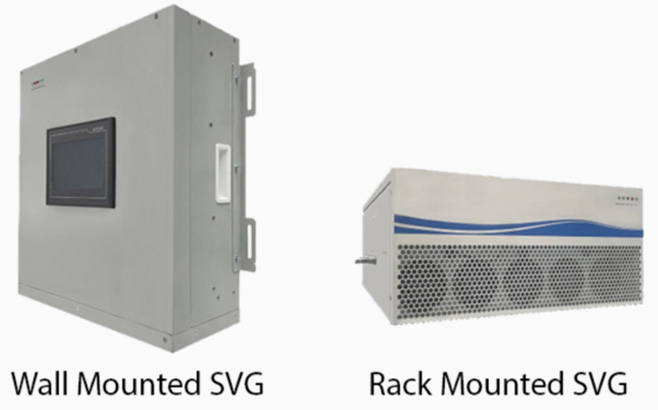
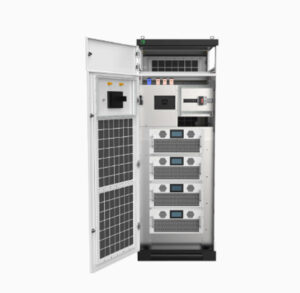
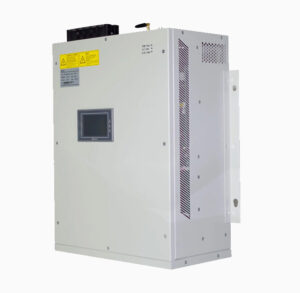
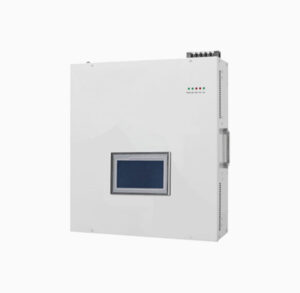
Installation method | Rack mounted, wall mounted |
Cooling method | Speed regulation intelligent air cooling PWM Fans |
Level of protection | IP20~IP54 |
Environmental Specification | |
Ambient temperature | -20 ~ 55 ℃ (rated power output) |
Environment temperature | -30~70℃ |
Relative humidity | 95 % at a maximum, no condensation |
Altitude | Below 1500 meters above sea level |
Cooling requirements | Require well ventilation, and the air vent can be opened through the cabinet door, or a fan installed in the cabinet |
Typical Applications

Industries using VFD-driven motors

Solar inverter-based plants

Plastic, textile, metal & food processing plants

Data centres & IT parks

Commercial buildings with heavy non-linear loads

Hospitals (MRI, CT, X-ray, critical loads)
Product Portfolio
Mechanical Drawings
FAQs
What is a Static Var Generator (SVG)?
A Static Var Generator (SVG) is an advanced electrical device used to enhance power quality by managing reactive power in real time. It helps maintain stable voltage levels and improves the power factor by either supplying or absorbing reactive power instantly. Compared to traditional capacitor banks, SVGs provide continuous and dynamic compensation, making them effective even under rapidly changing load conditions.
How do you choose the right SVG?
Selecting an SVG depends on several key considerations:
- Reactive power requirement: Calculate the required kVAR capacity based on your system’s needs.
- Type of load: Ideal for environments with fluctuating loads such as welding units, data centers, and heavy industries.
- Response speed: Prefer systems with fast response times (typically under 5 ms) for dynamic applications.
- Voltage compatibility: Ensure it matches your system’s voltage level and overall capacity.
- Installation conditions: Consider whether it will be installed indoors or outdoors, along with environmental factors like heat, dust, and humidity.
How is an SVG different from a Capacitor Bank?
- SVG: Uses IGBT-based technology to deliver continuous, real-time reactive power compensation with precise control.
- Capacitor Bank: Operates in fixed or step-based modes, which can sometimes result in over- or under-compensation.
What is the difference between SVG and Active Harmonic Filter (AHF)?
| Feature | SVG | AHF |
|---|---|---|
| Main Function | Reactive power compensation | Harmonic filtering + power factor correction |
| Key Advantage | Stabilizes voltage and improves power factor | Reduces harmonic distortion |
| Ideal Use | Voltage stability and PF correction | Environments with heavy harmonics (VFDs, UPS, nonlinear loads) |
| Technology | IGBT-based dynamic compensation | IGBT-based harmonic filtering |
| Response Time | <5 ms | <1 ms |
| Harmonics Impact | Does not remove harmonics | Actively eliminates harmonics |
Is SVG suitable for all load types?
SVG works best with dynamic and reactive loads, such as:
- Welding machines
- Elevators and cranes
- Renewable energy systems (solar and wind)
- Heavy industries (steel, cement, chemical plants)
- Data centers, hospitals, and airports
However, it has minimal impact on purely resistive loads like heaters.
Can SVG and AHF work together?
Yes, they complement each other:
- SVG: Improves power factor and manages reactive power
- AHF: Eliminates harmonics and reduces THD
Using both is highly effective in systems with nonlinear loads like VFDs and UPS systems.
What is the difference between STATCOM and SVG?
Both technologies operate on similar principles using power electronics for fast compensation. The main distinction lies in their application:
- STATCOM: Used in high-voltage transmission networks
- SVG: Commonly applied in low- and medium-voltage industrial or commercial systems
How fast does an SVG respond?
Modern SVG systems use IGBT technology and can respond within 5 milliseconds or less. This makes them significantly faster than traditional solutions like TSC or SVC, especially in handling rapidly changing loads.
How does SVG compare with TSC (Thyristor-Switched Capacitor)?
| Feature | SVG | TSC |
|---|---|---|
| Control | Continuous electronic control | Step-based thyristor switching |
| Accuracy | High precision, stepless | Limited precision |
| Response Time | ≤5 ms | 10 ms to 1 second |
| Harmonics | Does not generate harmonics | May cause resonance issues |
| Best Application | Dynamic loads | Stable loads |
| Maintenance | Low maintenance, long life | Higher maintenance due to switching wear |
Can SVG be used in renewable energy systems?
Yes, SVG is widely used in solar, wind, and energy storage systems. It helps by:
- Improving power factor to meet grid standards
- Balancing phase currents
- Reducing voltage fluctuations and flicker
Does SVG help save energy?
While SVG does not directly reduce energy consumption, it helps lower operational costs by:
- Improving power factor and avoiding penalties
- Reducing transmission losses
- Enhancing equipment efficiency and lifespan
How do you determine SVG capacity?
To select the correct capacity:
- Measure the system’s reactive power demand (kVAR)
- Choose an SVG rating slightly above peak demand
For complex systems, consider using multiple distributed units
Can multiple SVG units operate together?
Yes, SVGs support parallel operation, allowing scalability:
- Add units as demand increases
- Install at different points in the system for better efficiency
Where should an SVG be installed?
For best performance, install SVG close to the load:
- At substations or distribution panels (centralized)
- Near load centers or production areas (decentralized)
- Directly near specific equipment like VFDs or welding machines
What is the lifespan and maintenance of an SVG?
SVG systems typically last 15–20 years. Maintenance is minimal and includes:
- Checking cooling systems
- Cleaning dust
- Monitoring system performance
What is the ROI of an SVG?
SVG systems usually offer a return on investment within 1–3 years, depending on:
- Electricity tariffs and penalty structures
- Savings from improved power factor
- Reduced maintenance and longer equipment life
Which industries benefit most from SVG?
SVG is especially useful in industries with fluctuating or heavy reactive loads, such as:
- Manufacturing (steel, chemical, cement)
- Data centers and large motor applications
- Ports, cranes, and elevators
- Renewable energy systems
It can also be combined with AHF, TSC, or SVC for a complete power quality solution.